
You say a familiar phrase, and your dog pauses with one ear a little higher than the other. It is an expression you might recognize instantly in a photograph. Understanding it takes more than looking at the angle of the head.
Why do dogs tilt their heads? Brief tilts during interaction may relate to attention and processing information, but there is no single proven explanation for every dog and every situation. The most useful clues are what happened before the movement, how long it lasted, and what your dog did next.
A head that stays tilted, especially with a new change in balance or comfort, belongs in a veterinary conversation. Keep that distinction in mind as you observe an ordinary listening moment.
Start with the situation around the movement
Describe what you can see before deciding what it means. Your dog might pause after a word, look toward a sound, or turn toward you while you hold an object. Those details give the movement a context that a still photograph cannot provide.
Several explanations have been proposed for brief tilting. VCA Animal Hospitals discusses hearing, visual perspective, and responses to human attention. These are possible contributors; they do not establish the reason for an individual tilt. Avoid treating one explanation, such as getting a better view around the muzzle, as a settled answer for every dog.
For an everyday example, imagine saying your dog's usual walking cue while holding a leash. A tilt at that moment occurs alongside several things: your voice, the object, your posture, and the routine. You cannot tell which one mattered simply by replaying a photograph of the pose.
Try a more modest description: “She tilted her head after I picked up the leash.” That preserves the interesting observation without assigning a thought you cannot verify.
What the word-learning research actually found
An exploratory study by Sommese and colleagues observed 40 dogs during tasks in which owners asked them to retrieve named toys. Dogs successful at learning the object names tilted their heads more often than the comparison group. The researchers suggested a relationship with processing meaningful information.
The study was about a particular task and a small group of unusually successful word learners. It did not establish that tilting causes understanding, or that counting tilts is a general intelligence test. Nor does it prove that your dog understands every sentence you say.
Researchers also observed individual preferences for tilt direction across repeated tests. That finding describes the dogs in those experiments; it is not a tool for interpreting a new, persistent one-sided head position at home.
The practical takeaway is limited but useful: familiar words can be part of the context worth noticing. Keep the task, the sample, and the uncertainty attached to the finding when you share it with another pet owner.
Give the rest of the interaction equal attention
A pose can look questioning, affectionate, or comical to us. Those are ways people experience the image, rather than precise translations of a dog's thoughts. You can enjoy the expression while leaving its exact meaning open.
Watch the sequence instead of selecting only its most photogenic instant. Did your dog approach, pause, turn away, or return to another activity? Was the tilt something you already knew well, or a new posture you had not seen before? Notice the difference between a brief movement and a head position that remains after the interaction ends.
Body language also deserves a wider view than a single facial feature. Our guide to why dogs stare at their owners explores another behavior where context changes the interpretation. It can help you resist reading every attentive-looking expression as the same message.
If two family members describe the moment differently, compare the observable details. “He looked toward the cupboard and then walked over” gives you something concrete to discuss. “He definitely understood the whole conversation” goes further than the observation supports.
Keep an observation note simple and useful
You do not need to stage experiments or repeat sounds to get a useful record. If a familiar tilt happens naturally, jot down what was going on. A short, ordinary description is easier to compare later than a label such as “being clever.”
Useful details include:
- What was happening just before the tilt, including any words or sounds you noticed.
- Whether the movement was brief or the head remained in that position.
- What your dog did afterward and whether anything else seemed different.
- Whether this was a familiar pattern or something new.
For example, a hypothetical note could read: “After I said the usual dinner phrase, Fern tipped her head, straightened it, and walked to the kitchen.” It is a record of a moment, not evidence for a particular theory about hearing or language.
Avoid setting a target number of tilts, comparing your dog with a social-media clip, or repeatedly trying to reproduce the same response. A quiet observation can be complete even when there is no dramatic conclusion. If something seems unusual, the note is something you can describe to your veterinarian rather than a substitute for contacting them.
Take a persistent or new tilt seriously
A head that remains tilted needs a different response from a fleeting movement during an otherwise ordinary interaction. PDSA's veterinary guidance on head tilt advises contacting a vet for a constant tilt, even when no other symptoms are obvious. Possible causes include ear problems and conditions affecting balance; the appearance alone does not identify the cause.
Seek prompt veterinary advice if the tilt is new or persistent. Mention any stumbling, falling, circling, unusual eye movements, vomiting, or signs of ear pain. If your dog cannot stand, repeatedly falls, or seems severely unwell, contact an emergency veterinary service promptly.
A short video may help you communicate what happened if you can record it without delaying care or making your dog move unnecessarily. Tell the clinic when you first noticed the change. Let the veterinarian guide the examination and any treatment; do not use an online behavior explanation to decide that a persistent tilt is harmless.
Photograph a comfortable moment without demanding the pose
For a dog who is comfortable and behaving normally, a naturally occurring tilt can make a lovely candid image. Have your camera ready during an ordinary interaction and accept whichever expression your dog offers. There is no need to create a louder or stranger sound to obtain a particular angle.
Our dog portrait photography tips can help you plan the light and camera position before the moment arrives. Keep the full head and ears within the picture, and review the image for sharpness afterward rather than extending the session to chase perfection.
Choose a caption that describes the memory: “Waiting for our evening walk” can be more personal than a claim about what your dog was thinking. You may find that a straight-on look or a familiar resting posture says just as much about your companion. These portrait ideas drawn from everyday habits offer other moments to notice.
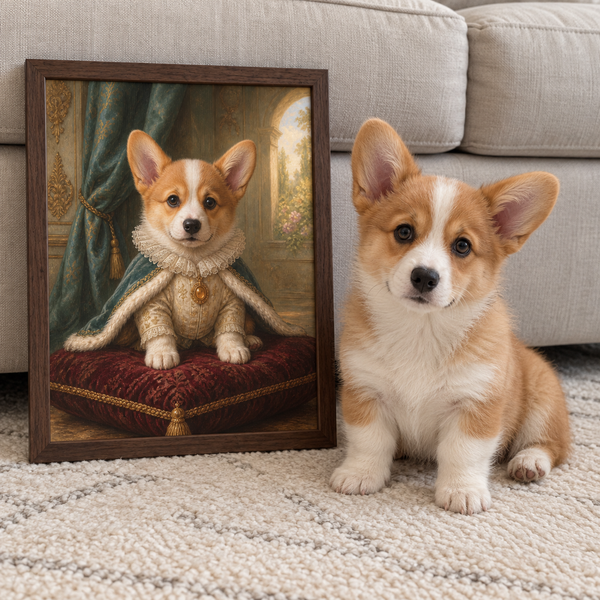
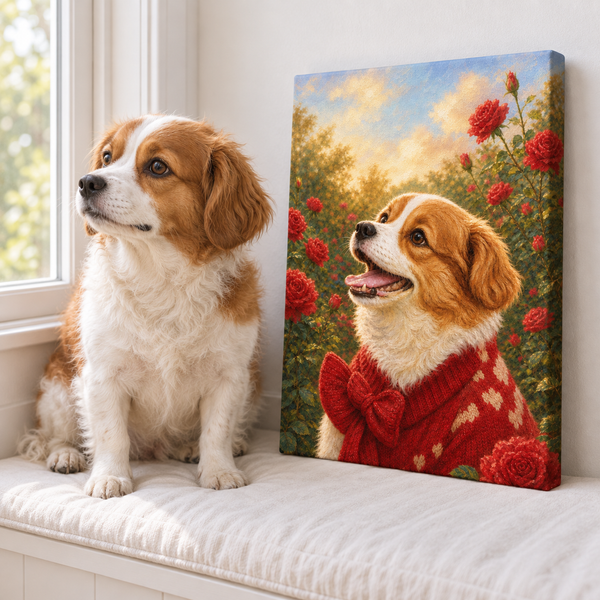
If you eventually want that image on the wall, explore Pawfolio's portraits from pet photos. Begin with a photograph that feels recognizable to you, while keeping health questions separate from your choice of artwork.
The next time a brief tilt catches your attention, look at the whole moment. Enjoy the expression, describe what you actually observed, and get veterinary guidance when the posture is new, persistent, or accompanied by other changes.