
Deciding what to write on a pet memorial plaque can feel much harder than choosing the plaque itself. The surface is small, the words are permanent, and no short inscription can contain an entire relationship.
It does not need to. A strong plaque usually does three modest jobs: it identifies the pet, marks time only as accurately as you know it, and preserves one detail that feels true. That detail might be a nickname, a familiar routine, a place, or the role the pet held in the family.
Use this simple structure as a starting point:
EVERYDAY NAME
VERIFIED YEARS OR ONE MEANINGFUL DATE
ONE TRUE LINE
You may use all three lines, two, or only the name. Brevity is not a measure of love.
Begin with the name you actually used
The best identity line is usually the name spoken at home. A registered name may matter for a show dog, working animal, or family tradition, but it should not displace the nickname that immediately sounds like your companion.
Write down every accurate version before deciding:
- everyday name;
- nickname;
- formal or registered name;
- a family role such as “our trail companion” or “window-seat supervisor.”
Then test each version at the actual plaque size. Long formal names, quotation marks, dates, and symbols consume more room than they appear to on a phone screen. If two names matter, place them on separate lines instead of compressing them into a crowded heading.
For a gift, verify spelling with the recipient. Do not copy a name from a social profile and assume the capitalization or nickname is correct. Apostrophes, accent marks, and intentionally unusual spellings deserve the same care as any other part of the memorial.
Add dates only when they are accurate and wanted
Birth and death dates are traditional, not mandatory. Include them when they help the family tell the story and you can verify them. Years alone often fit more comfortably than full dates.
If a rescue pet's birth date is unknown, do not invent one to complete the layout. Honest alternatives include:
- an adoption year and passing year;
- “Family since” followed by a verified year;
- one date that holds real meaning;
- no dates at all.
Choose a date style and keep it consistent. On a small plaque, 2012–2026 is easier to scan than two long written dates. On a larger marker, a full month-day-year format may be appropriate. Ask the maker whether punctuation, spaces, dashes, and symbols count toward the character limit.
Find one detail that belongs to this pet
Search results for pet memorial quotes can help you identify a tone, but a familiar detail often feels more durable than a phrase that could describe any animal. Instead of trying to summarize love, finish one of these private prompts:
- The room still reminds me of you when...
- You always waited for...
- Everyone knew you by...
- Home sounded like...
- Your favorite place was...
- The small thing I never want to forget is...
Circle the nouns and verbs that are unmistakably yours: the sunny stair, the morning leash, the slow blink, the thump of a tail against a cabinet. Then reduce the memory to a short line that still sounds natural when read aloud.
For example, a family might turn “She waited at the kitchen doorway every evening” into “Always at the kitchen door.” Someone remembering a cat's afternoon routine might choose “Keeper of the warm windowsill.” These are writing demonstrations, not customer quotations; the useful line is the one built from your own memory.
The AVMA's guidance on coping with pet loss notes that photographs, tributes, letters, and memories can be ways of continuing the relationship through remembrance. There is no requirement that a memorial be public, elaborate, or completed on someone else's schedule.
Choose the tone before choosing the words
Pet memorial wording can be affectionate, plain, playful, spiritual, formal, or private. Decide which tone fits the person who will live with the plaque.
Affectionate wording names the bond directly. Observational wording records a habit or place. Playful wording may preserve a family joke, but it works best when everyone involved recognizes it as loving. Spiritual wording should reflect the family's actual beliefs rather than an assumption about the afterlife.
For a sympathy gift, avoid making decisions the recipient has not approved. Confirm names, dates, pronouns, religious language, and any reference to the cause of death. A gift can include space for the owner to choose the final line instead of presenting grief as something already resolved.
Cornell's pet-loss resources emphasize that grief does not follow one normal timeline. If the wording feels impossible today, save a temporary version and return to it later. Waiting is a valid design decision.
Match the inscription to the object and location
A garden stone, brass plate, wood frame, urn nameplate, and indoor shadow box all create different limits. Before refining the sentence, ask the maker for:
- maximum characters and lines;
- whether spaces and punctuation count;
- the engraving area in inches;
- available fonts and minimum letter size;
- supported symbols and image formats;
- a layout proof showing final line breaks;
- material and care guidance for the intended location.
Outdoor placement introduces weather, dirt, changing light, and viewing distance. Indoors, contrast and reflections may matter more. A beautiful script that looks clear in a large product preview may be difficult to read when engraved at one inch high.
A practical memorial wording guide similarly recommends everyday names, optional accurate dates, and a short relationship line, while warning against inventing details to fill a template. Treat any seller's character limits as product-specific; only the maker of your exact plaque can confirm what fits.
Original wording directions to adapt
Rather than copying a long quote, use one of these structures to create your own line.
Name plus a familiar place
MILO
STILL WITH US ON EVERY TRAIL
Replace “trail” with the place your pet made meaningful: porch, garden, window, workshop, couch, lake, or kitchen.
Name, years, and a household truth
LUNA
2011–2026
THE QUIET HEART OF OUR HOME
Change the final line until it sounds like language your family would naturally use.
Name and a remembered action
SCOUT
ALWAYS FIRST TO THE DOOR
Actions are often more personal than adjectives. “Waited,” “followed,” “guarded,” “greeted,” “watched,” and “curled up” can lead you toward a specific memory.
Two pets on one plaque
Give both names equal visual weight. If dates create clutter, use separate name lines and one shared relationship line. Do not imply that two pets had the same dates or history unless that is accurate.
If you are considering dog memorial quotes short enough for engraving, use them as prompts rather than obligations. Rewrite any borrowed idea in your own plain voice, and avoid unattributed poetry or song lyrics that may be copyrighted.
Proof every character before engraving
Permanent personalization deserves a slow final check. Use this list after the layout is prepared, not only after the wording is drafted:
- Confirm the pet's name, spelling, capitalization, and punctuation.
- Verify dates from a veterinary record, adoption document, photographs, or another source you trust.
- Read the text aloud and remove any line that sounds unlike the family.
- Check pronouns, family roles, humor, and faith language with everyone who needs to approve them.
- Review the exact font, alignment, symbol, and line breaks at full size.
- View the proof from the likely reading distance.
- Save the approved wording outside the checkout or order form.
- Ask whether the maker sends a revised proof after corrections.
Do not approve a proof while looking only for the emotional message. Read it once backward, word by word, to force your eyes to notice spelling. Then compare every line against the saved final text.
Let the plaque be one part of remembering
A plaque can mark a garden, frame, urn, shelf, or private corner, but it does not have to carry every photograph and story. Longer memories can live somewhere else: a letter, album, digital folder, shadow box, or the pet memorial portrait ideas guide.
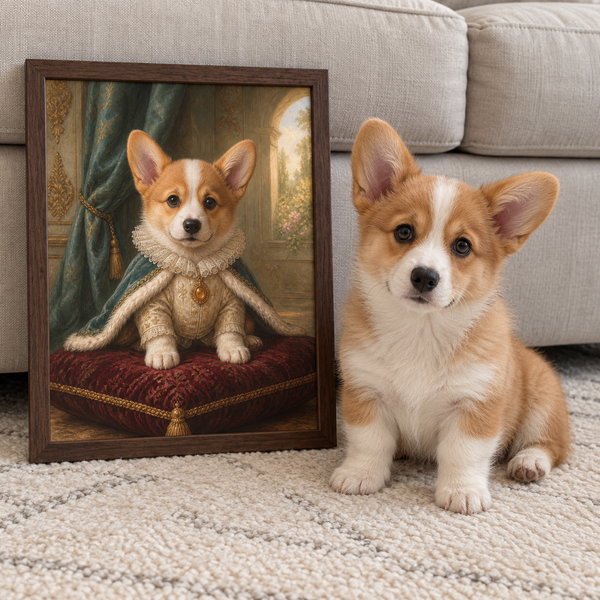
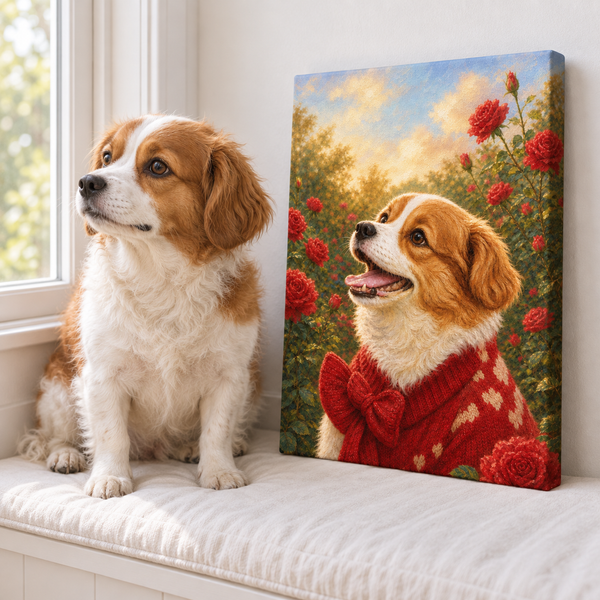
If a familiar expression feels more important than a long inscription, a custom pet Art Print from Pawfolio Art can sit near a small plaque with only the name and dates. The portrait and the words can do different jobs instead of competing for the same limited space.
For other gentle ways to protect a collar, tag, photographs, or written memories, see the pet memorial shadow box guide. And if you are supporting someone else, Pawfolio's guide to what to say when a friend loses a pet focuses on presence without minimizing grief.
The right inscription is not the most poetic one. It is the one that is accurate, readable, and recognizably about this pet. Begin with the everyday name, add only the dates you know, and save one true detail. That is enough for a small surface to hold.