


What do cats think about when they watch a hallway, pause at a familiar sound, or appear beside the food bowl one minute before dinner? The honest answer is less dramatic—and more interesting—than pretending we can hear an inner monologue. Science cannot translate a cat's private thoughts into words. It can test what cats notice, remember, distinguish, and expect, then compare their behavior when an expectation is met or broken.
That distinction matters. A slow blink may feel affectionate, a stare may look judgmental, and a midnight sprint can seem delightfully irrational. Those human interpretations can be part of living with a cat, but they are not the same as evidence. A more careful view starts with what researchers can observe.
We Can Study Thinking Without Reading a Cat's Mind
Animal cognition is often described through processes: taking in information, retaining some of it, and using it to guide behavior. Researchers might ask whether a cat notices that one voice differs from another, remembers where something happened, or looks longer when an event violates an expectation.
A broad review of domestic cat cognition research covers perception, object permanence, memory, physical causality, sensitivity to human cues, vocal recognition, communication, and attachment. It also emphasizes how much remains understudied compared with dog cognition.
So when we ask, “How do cats think?” the useful answer is not that they think exactly like small humans. Their attention is shaped by feline senses, movement, territory, past experience, and immediate needs. The strongest conclusions are about specific abilities—not a complete account of everything passing through a cat's mind.
Cats Pay Attention to Familiar Voices
Your cat may not come when called, but lack of approach does not necessarily mean lack of recognition. In a study of 20 domestic cats, researchers played several unfamiliar voices followed by the owner's voice while the owner remained out of sight. Cats mainly responded by moving their ears or head. The response pattern indicated that they could distinguish people using vocal cues alone, according to the published owner-voice recognition study.
That finding is a helpful reminder: a cat's response can be subtle. Dogs often make their attention obvious with movement toward a person. A cat may register the information, turn an ear, and stay exactly where they are.
In everyday life, familiar voices can become part of a larger web of associations. Your footsteps, the sound of a cabinet, the time sunlight reaches a certain chair, and the tone you use before play can all help predict what happens next. We cannot say the cat is narrating those events. We can say that learned cues influence attention and action.
Cats Can Form Expectations About Where You Are
One especially revealing experiment tested whether cats linked an unseen owner's voice to a location. After hearing the owner from one speaker, cats heard the same voice suddenly come from another place. They showed the greatest surprise when the owner appeared, acoustically, to move somewhere else without crossing the room. The researchers interpreted this as evidence that cats mentally represented the out-of-sight owner's location. You can read the 2021 socio-spatial cognition study for the full design and limitations.
This does not prove that a cat spends the afternoon daydreaming about a person. It does show that at least in this test, the owner's voice was more than background noise. It carried information about who was present and where that person should be.
That may help explain why a cat listens at a closed door, waits outside a usual room, or appears when a particular household routine begins. Each behavior has multiple possible explanations, but cats can use social and spatial information together.
Daily Cat Thoughts Are Probably Practical
When people wonder what cats think about all day, the most defensible categories are practical ones tied to behavior.
Resources and routine
Food, water, litter areas, sleeping spots, warm surfaces, and safe hiding places matter because cats use them repeatedly. A predictable routine makes those resources easier to locate and anticipate. If your cat waits by a bowl before a scheduled meal, learned timing and household cues are simpler explanations than a human-style clock in their head.
Movement and possible prey
A bird outside, a moth near the ceiling, or a toy moving behind a chair can hold intense attention. Cats evolved with behaviors suited to detecting, stalking, and pouncing on small moving targets. Indoor play can engage parts of that sequence even when no real hunt is taking place.
Changes in the environment
A grocery bag on the floor, a moved chair, a visitor's scent, or a new sound can deserve investigation. Cats do not have to be “paranoid” to monitor change. Novel information may affect access, safety, hiding options, or routes through a familiar space.
Social partners
Cats can learn individual people, voices, habits, and interaction patterns. They may seek proximity, food, play, warmth, or a familiar resting place near someone. The meaning of one approach depends on context, which is why reading the whole body is better than assigning one emotion to a single gesture.
If you want to make everyday interaction easier to interpret, our guide to how to pet a cat uses a consent-first pause rather than assuming every approach is a request for touch.
Memory Is Often Built Around Useful Associations
Cats learn which actions and cues lead to outcomes. A carrier may predict travel. A specific drawer may predict treats. A wand toy may predict a chase. Repetition strengthens some of these associations, while one unpleasant event can also make a place or object worth avoiding.
This kind of learning is not “less real” than verbal reasoning. It is simply a different way of organizing experience. The cat does not need a sentence such as “the blue cupboard contains my dinner” to behave as though that location matters.
Routine-related behavior also changes with context. A cat kneading a familiar throw may be engaging in a comfortable, repeated ritual rather than solving a new problem. Our article on why cats knead blankets separates common relaxed kneading from fabric chewing or ingestion that deserves closer attention.
What About Love, Guilt, or Revenge?
Words such as love, jealousy, guilt, and revenge bundle together feelings, motives, and human social rules. A cat can form social preferences and behave differently around familiar people without giving researchers direct access to a human-equivalent emotional story.
It is especially risky to label an unwanted behavior as revenge. Urinating outside the litter box, scratching a new surface, hiding, or becoming unusually vocal can relate to environment, learning, stress, access, or health. A moral explanation may feel satisfying, but it can delay a practical response.
Look first at what changed. Is the litter area accessible and clean? Did a new animal, person, sound, or object enter the home? Is the behavior sudden? Does the cat show changes in appetite, movement, elimination, or comfort? Sudden or concerning changes belong in a conversation with a veterinarian, not in a story about spite.
A Better Way to “Ask” What Your Cat Is Thinking
You cannot ask for a verbal answer, but you can run a gentle observation exercise.
- Name the context. Note the location, time, people, sounds, and resources nearby.
- Describe behavior without interpretation. “Ears turned toward the door” is more useful than “suspicious.”
- Watch what happens next. Does the cat approach, retreat, eat, play, groom, or settle?
- Repeat across several days. A pattern is more informative than one memorable moment.
- Keep choice available. Let the cat leave, pause contact, or choose a different resting place.
This method will not decode a private thought. It can reveal what reliably captures your cat's attention and what helps them feel comfortable.
Let Personality Stay a Little Mysterious
Science gives us useful pieces: cats distinguish familiar voices, connect some voices with expected locations, learn routines, and respond to social and environmental cues. It also gives us a necessary limit. Behavior supports careful inferences, not a word-for-word translation of the feline mind.
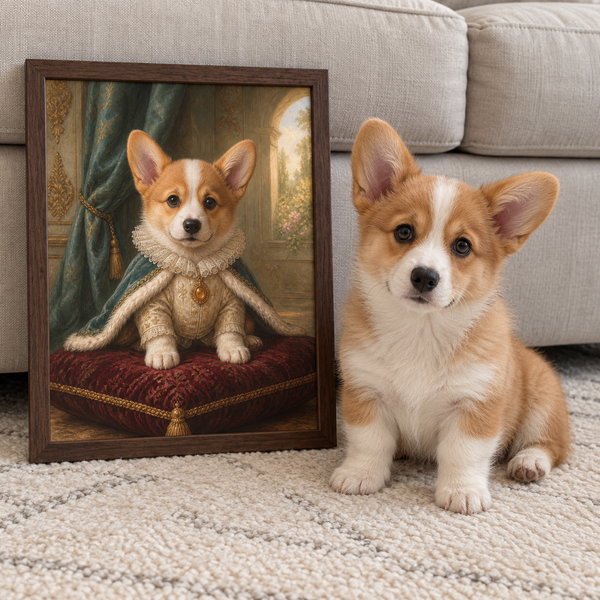
That uncertainty does not make your relationship less meaningful. It invites better observation. Notice the ear turn, the chosen chair, the pause before play, and the expression your family recognizes instantly. Those individual details are also what make custom pet portraits feel personal: not a generic idea of “a cat,” but the face, markings, and quiet habits that belong to yours.
If you are deciding which visual details best capture that individuality, these cat portrait ideas can help you move from a favorite expression to a portrait concept without pretending one image explains everything your cat thinks.