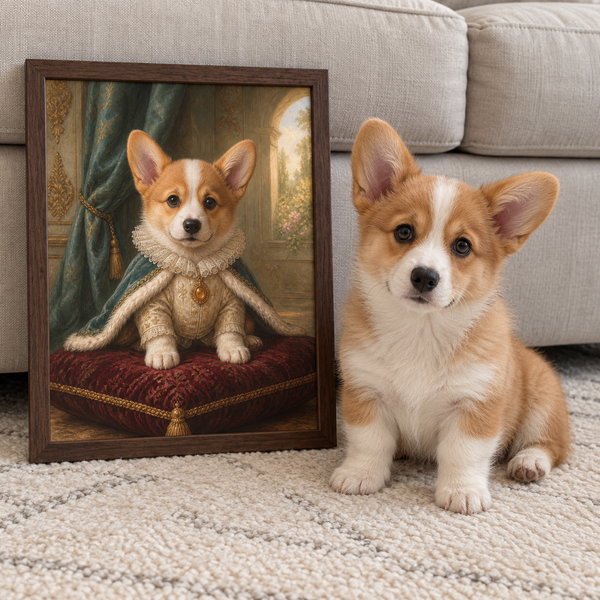
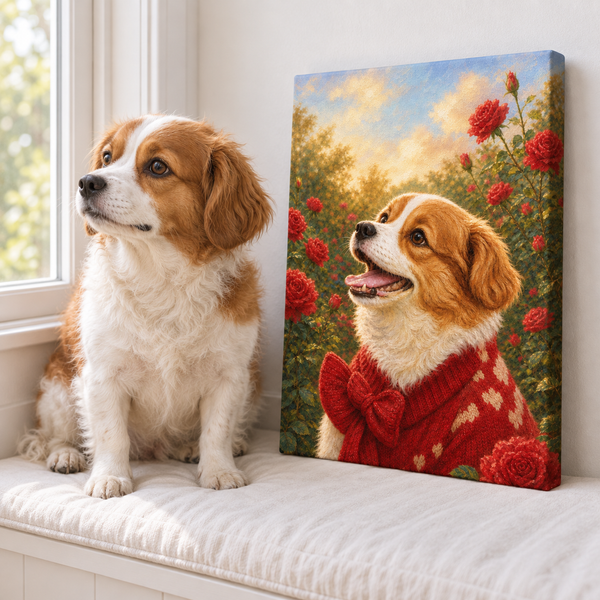

Victorian dog paintings were more than decorative pictures of fashionable breeds. They could present a named companion, signal status, tell a sentimental story, or give an animal the visual seriousness normally reserved for a human sitter. The best-known works still feel immediate because pose, gaze, setting, and likeness work together.
That history also offers a useful modern lesson: a “Victorian” pet portrait does not need every possible period prop. One clear character, a controlled palette, and a recognizable face are usually more convincing than a pile of crowns, medals, and furniture.
What Victorian dog paintings communicated
Why dogs mattered in Victorian visual culture
The Victorian era in Britain ran from 1837 to 1901, but dog portraiture did not begin or end at those dates. What changed was the visibility of dogs as domestic companions and carefully identified subjects. Royal patronage, breed culture, painting, print, and photography all helped shape the images people saw. Victorian pet portraits included more than dogs, and Victorian animal portraits could carry very different meanings depending on whether the subject was a companion, a working animal, or part of a human family scene.
The Royal Collection describes how Queen Victoria and Prince Albert documented many of their dogs and commissioned Sir Edwin Landseer to paint favorites such as Dash and Eos. The collection’s overview of royal pets places those animals within a longer tradition of dogs appearing beside royal families.
Museums also preserve less formal evidence of attachment. The Victoria and Albert Museum’s survey of pet portraits in its collection includes commissioned memorials, observational sketches, and animals placed within human portraits. Together, they show that Victorian animal imagery ranged from public display to private study.
Likeness came before costume
Landseer’s 1836 portrait of Queen Victoria’s spaniel Dash is useful because the dog is not turned into a tiny human. Dash is identifiable as a companion through his alert posture, silky coat, direct attention, and carefully observed form. The portrait was a birthday gift, but its emotional force comes from the particular animal rather than a generic emblem.
The same principle applies when planning a modern royal-style portrait. Start with what makes the dog recognizable:
- ear set and ear length;
- muzzle shape and head angle;
- eye color and the direction of the gaze;
- coat pattern around the face and chest; and
- the expression the household knows best.
Costume and setting should support those cues, not cover them. A high collar that hides a distinctive neck patch or a hat that changes the ear silhouette can weaken likeness even when the historical styling looks impressive.
What pose and setting communicated
Historic portrait conventions gave viewers quick information. A dog placed on a cushion in a finished interior belonged to a domestic world. A hunting dog outdoors suggested work, land, and activity. A low viewpoint could give a small animal unusual presence. A direct gaze created contact, while a turned head could make the scene feel watchful or narrative.
Tate’s record for Landseer’s King Charles Spaniels (The Cavalier’s Pets) is one museum example of dogs treated as the central subjects of a finished painting. The dogs’ placement and attention make the scene feel composed rather than incidental.
For a new portrait, decide what the pose should say before choosing a background. “Calm and observant,” “proud but playful,” and “quiet household ruler” lead to different choices. A straight seated pose fits formality. A slight head turn adds curiosity. A relaxed chest-up crop can feel intimate even within a dark, traditional palette.
Build a Victorian palette without making it muddy
Victorian-inspired interiors are often associated with deep green, burgundy, brown, navy, and muted gold. Those colors can frame a dog beautifully, but only if the coat stays separate from the background.
For a black dog, use a lighter edge, warm brown backdrop, or controlled rim light so the ears and shoulders remain visible. For a white or cream dog, a dark green or burgundy field creates contrast, but avoid blowing out the fur until it becomes a blank shape. Brown dogs benefit from backgrounds that are either distinctly cooler or clearly darker than the coat.
Repeat one coat color subtly in the room, then choose a contrasting accent. A tan dog might sit against deep green with a small brass note; a gray dog can work with burgundy and warm wood. Texture should be visible but subordinate. Velvet, carved wood, and drapery can suggest a period without competing with the face.
Use a source photo that preserves the dog
A period-inspired setting can replace the kitchen, yard, or car visible in the original photograph. It cannot reliably restore facial information that was never captured. Choose a source photo with sharp eyes, even light, an uncropped head, and no heavy filter.
Photograph the dog at eye level or slightly above. Avoid a very wide phone lens held close to the nose, which can exaggerate the muzzle. If a seated full-body composition is the goal, include the chest, front legs, and paws. If you want a head-and-shoulders portrait, concentrate on the face and ear edges.
The dog portrait photography guide offers simple ways to capture expression without forcing a long session. The broader Pawfolio photo guide can help when comparing several possible images.
Do not dress a dog in uncomfortable clothing just to create a reference. Photograph the animal safely and naturally; costume can be part of the artwork rather than the photo session.
Borrow the structure, not a specific painting
Historical reference is useful when it is treated as a visual vocabulary. You can borrow a three-quarter pose, controlled light, dark ground, framed interior, or restrained palette without reproducing a museum work line for line.
Choose one reference for posture, another for color, and a third for room mood. Then return to the dog’s own features. This produces a portrait that feels period-inspired while remaining personal. It also avoids turning a famous composition into a template with only the face changed.
If you want more context on earlier court-painting traditions, Pawfolio’s guide to Renaissance dog paintings explains how status, symbolism, and modern royal pet portraits relate without treating every old-master image as the same style.
Plan a royal-style portrait around one character
Begin with a short character sentence: “Mabel is composed, observant, and quietly in charge,” or “Otis is cheerful, earnest, and convinced every visitor came to see him.” Use that sentence to filter the visual choices.
Then decide:
- Crop: head and shoulders for intimacy, or seated body for formality.
- Role: duchess, officer, scholar, explorer, or simply a dignified companion.
- Palette: two main colors plus one small accent.
- Background: drapery, library, painted landscape, or a near-dark studio ground.
- Likeness checkpoint: eyes, muzzle, ears, and coat markings must remain clear.
Pawfolio Art’s royal pet portraits offer examples of character-led designs across Art Print and Canvas options. The most useful way to browse is not to ask which costume is grandest. Ask which role fits the dog and which palette belongs in the room where the piece will hang.
Victorian dog portraits still appeal because they take the animal seriously while leaving room for affection and wit. Keep the face specific, the setting controlled, and the story simple. That combination will feel more personal than adding another ornament to an already busy scene.