
Long before dogs became the stars of phone galleries, they appeared beside rulers, saints, hunters, families, and mythological figures in European art. Sometimes they helped identify a story. Sometimes they suggested loyalty, status, or companionship. And sometimes the dog's alert face and physical presence became fascinating enough to command attention on its own.
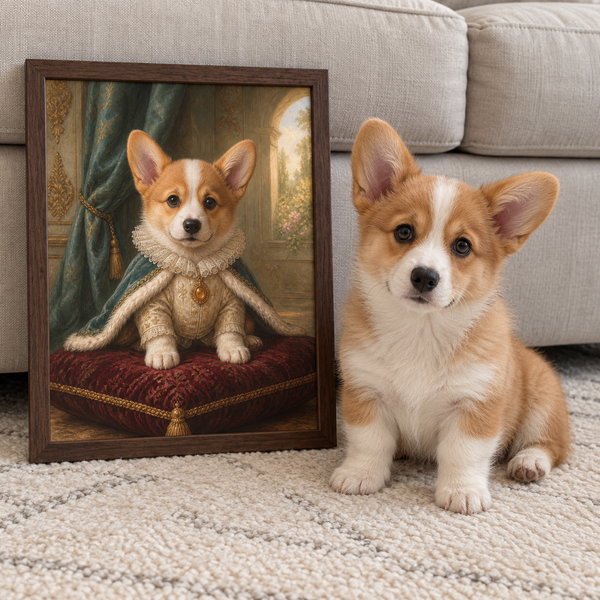
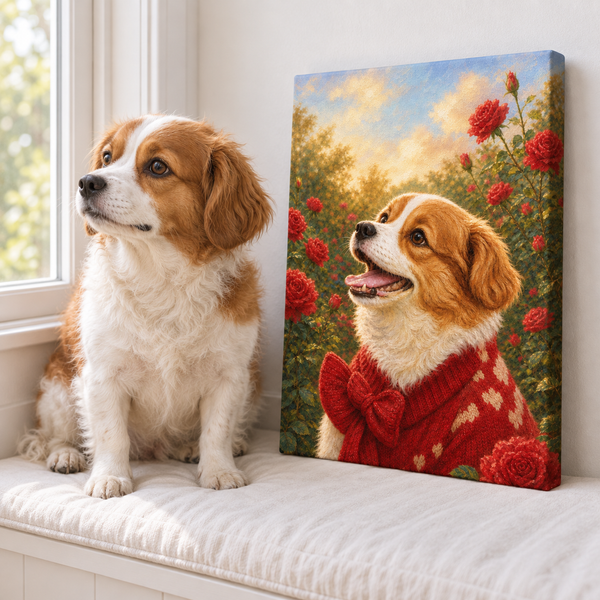
That history helps explain the appeal of today's royal pet portraits. A modern Royal pet portrait on Canvas is not a Renaissance original or a copy of one. It borrows a visual language—formal pose, costume, rich color, and ceremonial setting—and gives a familiar pet an unexpectedly grand role.
Dogs carried meaning in European painting
The meaning of a dog in an old painting depends on its context. The National Gallery's overview of dogs in painting shows them appearing in domestic, religious, and mythological scenes. In Jan van Eyck's Arnolfini Portrait, for example, the small dog may symbolize fidelity. In other works, dogs participate in a saint's legend, accompany a hunt, or help identify a mythological figure.
That variety matters. There is no single code in which every painted dog means “loyalty.” A lapdog in an interior, a hound in a hunting scene, and a dog at the feet of a mythological figure serve different narrative and social purposes. Looking at the setting, the human figures, and the dog's action gives a better reading than applying one symbol to every image.
Dogs also became worthy subjects in their own right
Symbolism is only part of the story. Artists and patrons also paid close attention to dogs as individual animals. The Metropolitan Museum of Art's exhibition catalogue Dürer and Beyond: Central European Drawings, 1400–1700 discusses dogs becoming works of art in their own right rather than merely accessories. It connects this development to the appreciation of prized companions and hunting animals in the sixteenth and seventeenth centuries.
This shift feels surprisingly current. Pet owners today recognize differences that an unfamiliar viewer might miss: a particular brow shape, a white patch that leans to one side, the way one ear rises before the other, or an expression that appears only when the pet is waiting for attention. A successful modern portrait depends on that same willingness to see an animal as an individual subject.
What makes a portrait look “royal”?
Royal portraiture communicates status through a collection of visual choices. Costume is the most obvious, but pose, viewpoint, color, lighting, and background are just as important.
Giovanni Bellini's Doge Leonardo Loredan is a useful example. The National Gallery notes that the half-length format recalls classical portrait busts of emperors. The three-quarter view, official costume, ultramarine background, and carefully modeled light give the sitter authority and presence.
Those elements continue to shape how viewers read a regal image:
- Centered or stable pose: A composed figure feels more authoritative than a hurried snapshot.
- Formal costume: Rich fabric, uniforms, jewelry, and structured collars imply ceremony and rank.
- Controlled expression: A direct or calm gaze can feel dignified, even when the subject is a playful dog.
- Deep color: Jewel tones, dark neutrals, and warm golds create visual weight.
- Architectural or painted setting: Columns, drapery, landscapes, and quiet studio backgrounds separate the portrait from everyday life.
A royal pet portrait works through contrast. The visual language is grand, while the subject is personally familiar. That tension is what makes the result both decorative and affectionate.
How modern royal pet portraits adapt the tradition
Modern pet art does not need to pretend that a dog once sat for a Renaissance court painter. Its value comes from transformation rather than historical imitation.
The process begins with a real photograph. The pet's face and recognizable features become the anchor, while costume and setting change the story around them. A solemn dog may become a commander or noble heir. A cat with an unbothered gaze may suit a duchess or regent. A bright, curious expression can work with a more adventurous historical character.
The strongest result keeps three layers in balance:
- Likeness: The eyes, coloring, markings, ear shape, and facial proportions still feel true to the pet.
- Character: The selected role complements the expression rather than fighting it.
- Composition: The head, costume, background, and final crop look like one coherent portrait.
That balance is why the source image and proof matter as much as the costume.
Choose a Royal style that fits the expression
Begin with the pet, not the title of the design. Look at the photograph and describe the expression in a few words: calm, alert, mischievous, gentle, proud, sleepy, or curious. Then choose a visual role that makes that quality more vivid.
- A steady frontal gaze can support a formal military or statesman composition.
- A soft, slightly turned expression may suit an elegant noble portrait.
- A bright, alert pose can work with an explorer or adventurous character.
- A relaxed cat may look especially convincing in an ornate, self-possessed role.
- A multi-pet image needs a composition that gives each face enough space and hierarchy.
Do not worry about matching the pet's sex to a costume unless that matters to you. The portrait can be sincere, humorous, theatrical, or all three. What matters is that the final character feels intentionally chosen.
Pick a photo that can carry the transformation
Elaborate costumes cannot compensate for a face with too little detail. Choose a close, well-lit image where the eyes, ears, coloring, and distinctive markings are visible. A neutral original background is helpful but not essential because the artwork can introduce a new setting.
For the cleanest result:
- photograph at or near the pet's eye level;
- use daylight or a bright room instead of harsh flash;
- avoid beauty filters and heavy color edits;
- keep the full face and both ears in frame when possible;
- choose an expression that suits the intended character;
- provide separate clear photos if more than one pet will appear.
Pawfolio's Pet Portrait Photo Tips gives a quick checklist for evaluating the image before upload.
Choose Canvas or Art Print for the display
The Royal series can create a formal statement in more than one format. A Royal Art Print has a flat presentation and offers flexibility for a classic framed-art look. A Royal Canvas has visible depth, wrapped edges, and a solid-wood inner frame, giving the image a dimensional presence on the wall.
Consider the setting:
- Canvas can work well as a single statement piece above furniture or on a feature wall.
- An Art Print can join a group of framed family photographs or other flat artwork.
- A darker, richly colored design may need enough light around it to keep facial detail clear.
- An ornate portrait often benefits from some open wall space rather than a crowded arrangement.
Use the Art Print vs Canvas guide to compare construction and display style before choosing.
Review the proof like a portrait sitter
Before production, treat the artwork proof as the moment to inspect both identity and illusion. First check the pet: eyes, markings, coloring, ear shape, and expression. Then step back and look at the overall portrait. Does the head sit naturally with the costume? Does the lighting feel consistent? Is the crop balanced? Does the background support the face?
Request an edit when a detail weakens the likeness or composition. The purpose is not merely to place a pet's head into historical clothing. It is to make the final image feel coherent enough that the theatrical idea becomes convincing. Pawfolio's How It Works page outlines the photo, proof, and production steps.
Why the idea still works
Renaissance dog paintings and modern royal pet portraits belong to different worlds, but they share one appealing premise: an animal can be important enough to look at closely. Historical paintings used dogs to support stories, identities, symbols, and social roles. Artists also learned to treat them as distinctive subjects worthy of observation.
Today's version is more personal and playful. It gives the visual authority of formal portraiture to the animal who waits at the door, steals the warm side of the bed, or supervises every meal. The costume may be imaginary, but the affection behind the portrait is entirely real.
If you are choosing a design, start with the expression you know best. Let the pose, role, colors, and display format make that personality larger—not replace it.