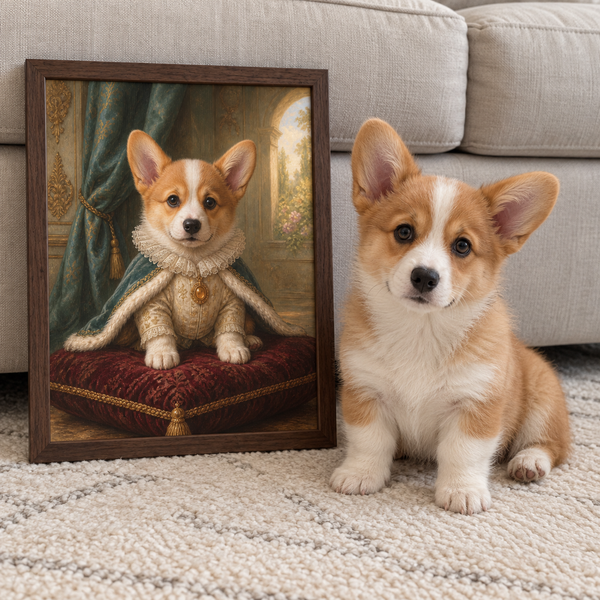
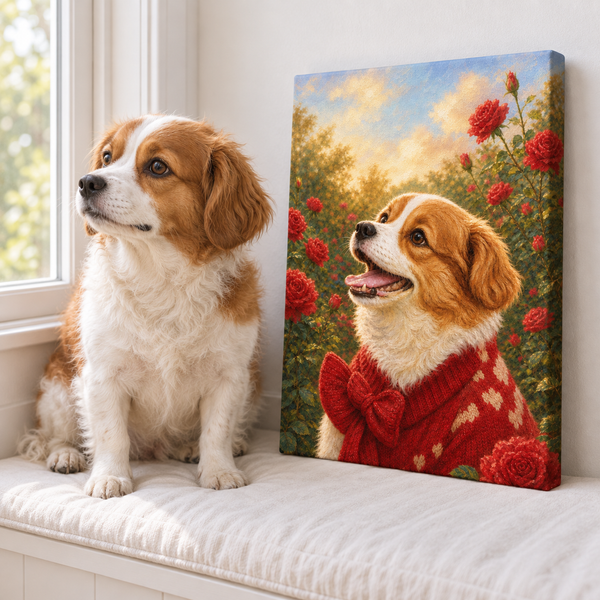

That photo of your dog deserves to leave your camera roll, but the plain frame on your shelf feels a little anonymous. You do not need an engraving machine or a pile of tiny charms to change that. A color pulled from the picture, a drawn paw motif, or a separate caption card can be enough.
The most useful photo frame decoration ideas for dogs leave the picture easy to see. Start with an ordinary frame you already own or an inexpensive craft frame, then choose one detail that feels specific to your dog. These projects are for everyday photo frames—not instructions for altering a finished portrait or a Pawfolio product.
Set up the frame without putting the photo at risk
Before you decorate anything, separate the photograph, removable mat, backing, and outer frame. Check how the frame closes and whether it has enough room for its existing contents. Do not add layers that make the backing buckle or the clips strain. If you cannot take the frame apart comfortably, choose a caption card that stands beside it instead.
Work with a new print or a copy of an important photograph. Put the original somewhere appropriate while you experiment. The Library of Congress's photograph-care guidance advises handling pictures by their edges or housing and keeping adhesive tape, sticky notes, and glue off photographs. That is a useful boundary for this project: decorate the surrounding object, not the image surface.
For a basic kit, gather a pencil, a ruler, scrap paper for testing layouts, and a separate piece of cardstock for a label. Add paint or markers only if their manufacturer says they suit the frame's material. Remove the contents first and follow the product's preparation and drying instructions. Keep the work area away from your dog and return the photograph only when the frame is ready to reassemble.
Repeat one color instead of decorating every edge
A narrow color detail is a straightforward way to personalize a dog picture frame. Look at the photograph before choosing a shade. A blue bandana, rust-colored leaves, or a green background gives you a starting point without adding another theme. Pick one of those colors, then let the rest of the frame stay quiet.
Test the idea on paper first. Cut a strip the width you are considering and place it near an edge while the photograph is safely set aside. A slim line along the bottom may look better than a full border. On a wide frame, a small color block in one corner can give the picture a different feel without surrounding the dog on all four sides.
If your frame is suitable for painting, apply the detail to its empty outer surface according to the paint and frame instructions. If it has a finish you do not want to alter, skip the paint. Use the chosen color on a freestanding caption card instead. You still get a coordinated look, and the frame remains unchanged.
Take a quick phone picture of your paper mockup. Looking at the smaller image can help you notice whether the color supports the dog's face or becomes the first thing you see.
Draw a paw motif rather than making a real paw print
A paw shape makes the subject clear, but it does not need to cover the whole frame. Sketch a simple pad and four small toes on scrap paper, then try the shape at one corner. Keep it flat and small enough that it does not extend into the photograph's opening. Two restrained motifs can work; a continuous trail may feel busy around an already detailed image.
This is a drawing project, not a reason to put paint or ink on your dog's feet. You can trace your own paper sketch, draw a small silhouette freehand, or use a stencil intended for the frame material. A slightly imperfect hand-drawn shape is perfectly usable. It does not have to look like a commercial logo.
For a frame you want to leave untouched, draw the motif on the separate caption card. That also makes it easy to change your mind later. Avoid loose beads, hanging tags, or a ribbon crossing the picture; this project works without dangling pieces.
Try the motif with the actual photo crop in mind. If your dog's ear reaches the upper corner, place the decoration somewhere else. The face, ear shape, and markings should have room before the frame gets its extra detail.
Give the name its own small caption card
A name can make an ordinary photograph feel more personal, but fitting it onto a narrow frame sometimes produces cramped lettering. Write or print it on a separate card and stand that card beside the frame. You can use the same accent color as the border or paw drawing without changing the photograph or its mat.
Keep the caption short. A name on the first line and a specific, optional detail beneath it are enough: “Milo / First beach trip” or “Juniper / Saturday lookout.” These are possible caption formats, not customer stories. Choose the detail from your own picture rather than adding a sentimental line that could describe any dog.
Before making the final card, try the wording on scrap paper and view it from the place where you usually sit. If you have to lean forward to read a long sentence, shorten it. Leave space around the letters instead of filling the card edge to edge.
A separate label is especially convenient if you change photographs seasonally. Make a few cards, store them apart from the prints, and swap the caption when you swap the picture. No adhesive needs to touch the photo, and the frame can stay part of your room year-round.
Turn one familiar walk into a companion detail
Sometimes the most recognizable part of a dog photo is the place around it: the curve in the trail, a favorite park bench, or the patch of shade where every walk slows down. You can acknowledge that setting without attaching a collar, tag, or keepsake to the frame.
On a separate card, draw a simple line suggesting the route or write the place name and month. Treat it as a visual reminder, not an accurate navigation map. Keep the line in the same palette as the frame's other detail. One small route sketch plus the photo can say more than a cluster of unrelated decorations.
If you are taking a new picture for the project, begin with a familiar stop and let your dog stay comfortable. The Pawfolio photo guide can help you assess face visibility and usable reference-photo details. You do not have to recreate the exact walk or get a perfectly posed expression to make a meaningful display.
Before posting a picture of your finished frame online, read the caption for personal information. You may prefer a park name over a precise home address or daily walking schedule. The card should tell the story you want to share, not every detail of the routine.
Make a matching pair, then stop adding details
If choosing one photograph is the difficult part, use two ordinary dog picture frames with one shared detail. A puppy photo and a recent photo could have the same small blue corner. Two dogs could have matching frame finishes with different caption cards. The connection can be subtle; you do not need to make every element identical.
For a pair, give each face comparable visual space. Check the crop before committing to a mat or decoration. If one picture has a busy background, let its frame be simpler. When you are ready to arrange the finished pieces, these dog photo display ideas cover the next task: deciding where and how they fit together.
Choose the display location with care, too. The National Gallery of Art's paper-conservation overview identifies light exposure, rough handling, and poor-quality housing among the sources of damage to works on paper. A craft project is not a conservation treatment, especially for an irreplaceable original.
If you would rather personalize the artwork than the frame, a custom pet art print is a different option. Pawfolio Art's Art Prints are flat prints on premium textured fabric with a water-resistant finish—not ordinary paper photographs. The Art Print vs Canvas guide explains the construction and external-frame options. Keep a finished product as supplied rather than applying these craft steps to it.
For your DIY photo frame, finish with a simple check: the dog's face is clear, the photo is untouched, the backing closes normally, and each added detail has a reason to be there. If something only fills empty space, leave that space empty.