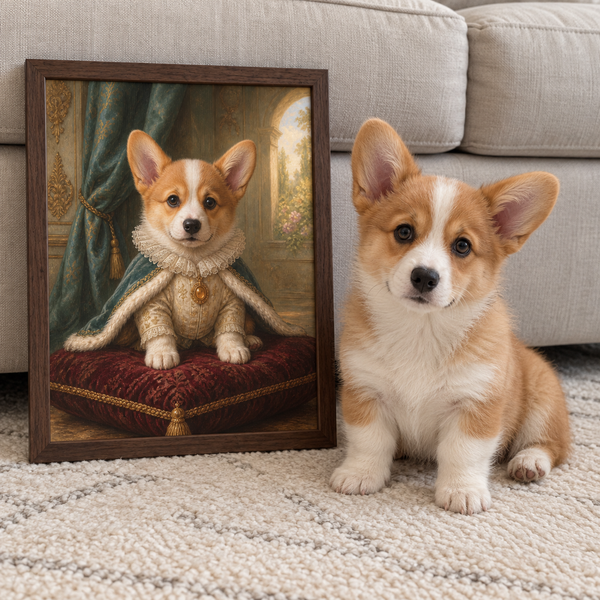
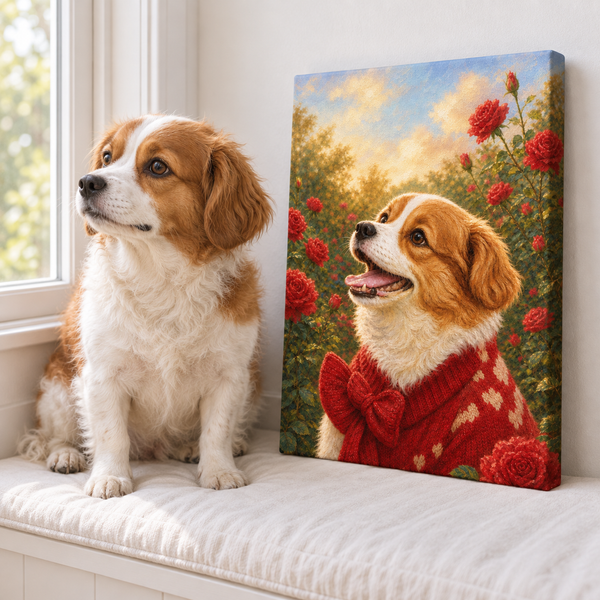


An empty bathroom wall can look like the perfect spot for your pet's portrait. You would see it every morning, the colors suit the towels, and the size seems right. Yet a wall that looks good in a photograph may spend part of each day surrounded by shower steam. Before choosing the artwork, consider what happens in the room when someone actually uses it.
So, can you hang canvas in a bathroom? There is no reliable yes for every print and every bathroom. For a sentimental piece, a dry, stable room is the more cautious choice. This guide helps you assess the proposed location, ask useful product questions, and find another display plan when the bathroom is a poor fit.
Start with how much the piece matters to you
A replaceable decorative image and a portrait you would be upset to damage deserve different decisions. Price alone does not settle that distinction. A small picture made from a favorite pet photograph may have more personal significance than a much larger piece elsewhere in the house.
Before comparing hooks or frame colors, ask whether you would be comfortable moving the portrait to another room now. If the answer is yes, you can solve the placement question without trying to make a difficult environment work. There is no need to use every empty wall for artwork.
MoMA's conservation guidance advises against displaying art in places with potentially high humidity or water leakage, specifically including bathrooms. That is a conservative preservation position, not a test result for every modern printed product. It is nevertheless a useful starting point for something you want to keep.
Write a short priority statement before shopping: “I want to see this portrait daily, and I would rather change the location than accept uncertain care conditions.” That gives you a practical way to evaluate alternatives. You are choosing a home for the picture, not proving that the original decorating idea must work.
Observe the room during its ordinary routine
Inspect the proposed wall after the room has been used, not only when it has been tidied for guests. Look for recurring condensation, splashes, damp patches, or signs of a leak. Notice whether the wall is beside a shower, above a sink, or close to pipes. These observations should inform the location decision before an artwork goes there.
Do not hang the portrait temporarily to see whether it survives. A paper sketch or a photograph of the empty wall can help you consider the composition without exposing the finished piece. Keep the actual Canvas in its current suitable location while you decide.
A room with a shower and a small toilet room without one have different uses. That difference is worth investigating, but the room's name is not an approval. A powder room can still have splashes, leaks, or other conditions that make a particular wall unsuitable.
An exhaust fan or window also does not prove that a print is appropriate for the room. Resolve persistent moisture problems as building-maintenance issues, then assess the artwork separately. If you cannot tell whether the location meets the maker's guidance, leave the portrait elsewhere rather than using it as a moisture indicator.
Identify what the artwork is made of
“Canvas” describes only part of an object. Canvas prints may also include a printed coating, a wooden support, an outer frame, and hanging hardware. Ask about the complete product rather than assuming a familiar material name tells you how the finished object will behave.
The Canadian Conservation Institute's environmental guidelines for paintings explain that humidity conditions and fluctuations matter to canvas and wood supports and to painting layers. Original paintings and printed canvases have different constructions. Use this source to understand why environment matters; do not turn its museum targets into a product specification or a household guarantee.
For the actual print, look for clear care and display instructions. Words such as “durable,” “premium,” or “fade-resistant” do not answer the bathroom question on their own. Ask whether the maker specifically permits the intended environment and whether any limitations apply to the frame or mounting system.
If you are also considering a flat print, the Art Print and Canvas comparison explains the format distinction. Adding glass or an outer frame should not be treated as automatic permission for a damp location. The complete assembly still needs appropriate guidance for where you intend to use it.
Ask a question the maker can actually answer
“Is this good for a bathroom?” leaves out the details that may matter. Describe the room, the proposed wall, and the product you are considering. Include whether the room contains a frequently used shower and whether the location has recurring condensation or splashes. A clear description is more useful than asking for a broad reassurance.
You can keep the enquiry short:
- Which care instructions apply to this exact print and finish?
- Is it intended for a bathroom with a shower?
- Are there restrictions on moisture exposure, mounting, or cleaning?
- If the location is unsuitable, which ordinary indoor conditions should I choose instead?
When browsing Pawfolio's Canvas portraits, compare the selected product's construction and options before deciding where it belongs. The Canvas artwork wraps over a solid-wood inner frame. That description explains its physical form; it does not establish waterproofing or bathroom suitability.
Save any relevant care answer with the order details. If you receive a general statement that does not address the location you described, ask for clarification before committing to that wall. You do not need an elaborate technical report, but you do need enough information to make the choice honestly.
Plan another place you will enjoy seeing
Start your alternative search with the same reason you liked the bathroom wall: you wanted the portrait to be part of an everyday routine. A bedroom, reading corner, or home-office wall may offer that regular view. Assess each location for its own light, moisture, heat, and handling conditions rather than assuming any neighboring wall is suitable.
Imagine a spaniel portrait originally intended for a narrow wall beside the shower. The owner instead considers the wall near a bedroom dresser. The morning routine still includes that space, and the picture can be enjoyed without making its display depend on shower use. This is a planning example, not a claim about a particular customer's home.
Once you have selected a suitable location, use the pet portrait size guide to compare the available space with the finished dimensions. Include any outer frame and check the view from where you normally stand or sit. A smaller piece in a useful position may serve your purpose well.
If you still want bathroom wall art, assess a separate decorative product whose maker explicitly supports that use. Check the complete product and mounting instructions. A material category by itself is not enough to promise suitability, and you do not have to make the sentimental portrait carry every decorating goal.
Keep the care plan with the display decision
For a Canvas already hanging in a bathroom, review the location and product guidance before leaving it there by habit. If the environment does not suit the piece, arrange a move to an appropriate location. Handle it according to the maker's instructions and seek advice if you notice damage or are unsure how to move it.
Do not add a spray coating, tape the back shut, or try a household treatment to make the print waterproof. Ask the maker about any proposed alteration first. A decorating decision should not quietly become an experiment on the image or its support.
Routine care is a separate task from choosing a room. Our guide to cleaning Canvas prints helps you approach that question without treating the printed surface like an ordinary washable household item. Keep the instructions for your actual product available whenever care is needed.
The final decision can be simple: suitable product guidance, suitable location, and a level of uncertainty you are comfortable accepting. If one of those is missing, choose another wall. The portrait can still belong in your daily life, even when the first place you imagined is not its best home.