
Renaissance cat paintings rarely announce themselves as pictures “about” cats. More often, a small cat sits near a chair, plays with wool, watches a bird, or slips through the edge of a domestic or religious scene. The animal may be easy to miss, yet it can change how the whole painting feels.
The most useful way to understand these cats is not to memorize one fixed symbolic definition. Look at where the cat appears, what it is doing, which figures or objects surround it, and how its behavior supports—or disrupts—the main story. A cat can make a distant narrative feel domestic, introduce tension, demonstrate an artist's powers of observation, or carry a meaning particular to that work.
First, look before interpreting
Renaissance viewers were accustomed to animals carrying moral, social, and religious associations. Medieval bestiaries had already connected animal behavior with lessons about human conduct. Renaissance artists inherited that visual language, but they also studied living bodies, household spaces, nature, and individual character with renewed attention.
That combination makes quick definitions unreliable. Art UK notes that animals in Renaissance art frequently appear as metaphors or emblems, but its examples also show how convincingly artists observed movement and physical presence. In Dosso Dossi's attributed Portrait of a Young Man Holding a Dog and a Cat, the two animals may suggest contrasting aspects of the sitter, while their shadowed faces also add mystery to the composition. The Art UK overview of animals in Renaissance art is a useful reminder that meaning grows from the specific scene.
Before deciding what a cat “symbolizes,” make a visual inventory:
- Where is the cat in relation to the main figures?
- Is it being watched, touched, teased, ignored, or concealed?
- Is it calm, alert, playful, hungry, or predatory?
- What object attracts its attention?
- Does its small action echo or contrast with the human action?
- Is the cat painted as an individual creature or a simplified sign?
These questions keep interpretation anchored to visible evidence.
Placement tells you how loudly the cat speaks
A cat near the center of the picture may participate directly in the narrative. One pushed toward a threshold, table leg, or lower corner may work like a visual aside: a detail that rewards close looking and broadens the world beyond the main event.
Scale matters. A tiny animal can make a room seem larger or bring an elevated subject down to household level. It can also guide the eye. Follow the direction of the cat's head, body, or gaze and you may be led toward a dropped object, another animal, or a secondary episode.
In Antonello da Messina's Saint Jerome in His Study, painted around 1475, the National Gallery notes that a ghostly outline of a cat can still be seen. The saint's study is presented through a broad stone arch, almost like a carefully opened interior. The barely visible animal belongs to that intimate environment. Rather than dominating Saint Jerome's scholarly identity, it helps the viewer feel that the sacred figure occupies a tangible, inhabited space.
Action is often more informative than species
Compare a sleeping cat with a cat stalking a bird. The species is the same; the narrative pressure is not.
In Pintoricchio's Penelope with the Suitors, from about 1509, a cat plays with a ball of wool. The detail sits naturally beside the story of Penelope, who delays remarriage by weaving during the day and secretly undoing the work at night. The cat's play is not merely decorative: it touches the material at the center of the tale and makes the room feel active beyond the line of suitors.
Federico Barocci's later The Madonna of the Cat, probably painted around 1575, places a household cat within a Holy Family scene. The infant Saint John the Baptist teases it with a goldfinch, traditionally associated with Christ's Passion. The cat's focused response introduces ordinary animal instinct into a scene that also anticipates a sacred future. The National Gallery's collection tour of cats in paintings discusses both works and shows why the neighboring object matters as much as the cat itself.
The useful question is therefore not “Are cats good or bad symbols?” It is “What does this cat's action do here?”
Domestic details can make sacred and classical stories immediate
Renaissance paintings often connect remote subjects with things a contemporary viewer could recognize: furniture, fabric, food, architecture, clothing, and animals. A cat behaving like a cat makes an imagined ancient or sacred setting feel present.
That domestic note does not cancel symbolism. It gives symbolism a believable body. A cat interested in food can signal appetite or opportunism, but it can also show a painter noticing how animals move through kitchens. A cat near a woman working with textiles can connect visually to thread, patience, interruption, or household labor. Multiple readings may coexist as long as they fit the scene.
An honors thesis in art history from the University of Iowa traces changing attitudes toward cats and dogs from the Middle Ages into the Renaissance. It argues that their roles became more nuanced as household relationships with companion animals developed. The thesis is one scholarly interpretation rather than a universal key, but it supports a valuable caution: historical meaning changes across time, place, text, and image. The University of Iowa thesis on cats, dogs, and household pets offers deeper context for that transition.
Try a six-step close-looking method
You do not need specialist vocabulary to read a Renaissance cat painting carefully. Use this sequence in a museum, book, or high-resolution image.
1. Describe only what is visible
Name the cat's color, posture, direction, and location without interpreting them. “A small pale cat crouches below the table and looks toward a plate” is a stronger starting point than “the cat represents greed.”
2. Trace the cat's visual relationships
Follow sight lines, repeated curves, colors, and gestures. Does the cat mirror a human figure? Does its body point toward the narrative center? Does its fur echo a textile or shadow?
3. Identify the scene type
A portrait, devotional painting, mythological story, and domestic moral scene create different expectations. An animal beside a sitter may say something about identity or status; an animal in a narrative may trigger an action or sharpen a lesson.
4. Examine nearby objects
Birds, fish, food, thread, collars, furniture, and thresholds can clarify the cat's function. In Barocci's painting, the goldfinch is essential. In Pintoricchio's, the wool connects the cat to Penelope's labor.
5. Research the individual work
Read the museum's object page, curatorial essay, and conservation notes. Titles and dates can change, attributions may be uncertain, and technical imaging sometimes reveals altered or painted-over animals. Work-specific evidence is more dependable than a generic symbol dictionary.
6. Return to the whole composition
After studying the detail, step back. Ask what would change if the cat disappeared. Would the room feel less lived in? Would a threat vanish? Would the eye move differently? The answer often reveals the animal's real contribution.
Renaissance-inspired pet art is a modern transformation
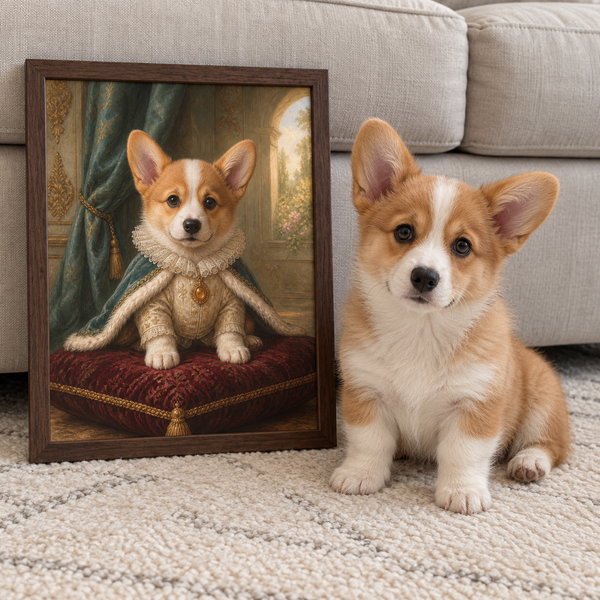
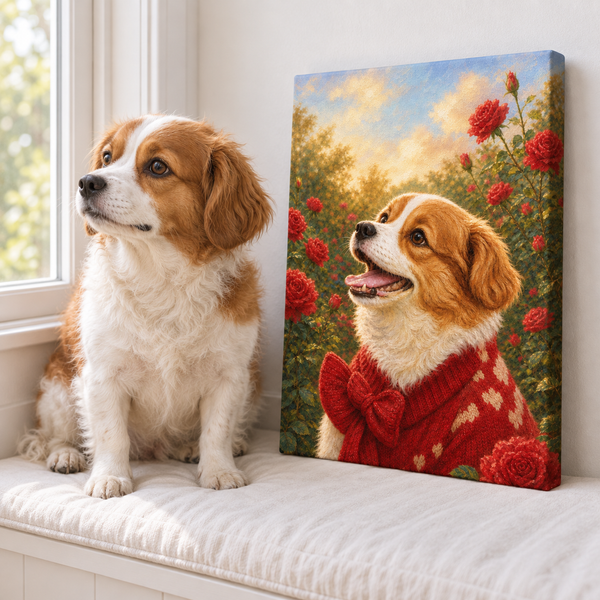
Historical cats often occupy supporting roles within larger religious, classical, or domestic narratives. Modern pet portraits reverse that hierarchy by making the companion animal the principal sitter. The visual vocabulary may borrow formal clothing, architectural settings, rich color, or courtly posture, but the purpose belongs to the present: celebrating an individual pet.
When considering that treatment, likeness still matters more than costume. Clear markings, eye color, ear shape, and expression keep the subject recognizable under the historical styling. Pawfolio Art's custom pet Art Prints offer one way to place a familiar face at the center while using art history as playful visual language rather than claiming to reproduce an original Renaissance work.
The small cat can unlock the entire painting
Renaissance cat paintings reward patient looking because the cat is often both ordinary and purposeful. Placement establishes importance. Action introduces story. Nearby objects supply context. Genre changes the range of plausible meanings.
Avoid reducing every cat to a single moral label. Begin with the visible animal, consult information about the particular work, and then test an interpretation against the whole composition. A small feline cameo may turn out to be the detail that makes a grand historical scene feel alive.