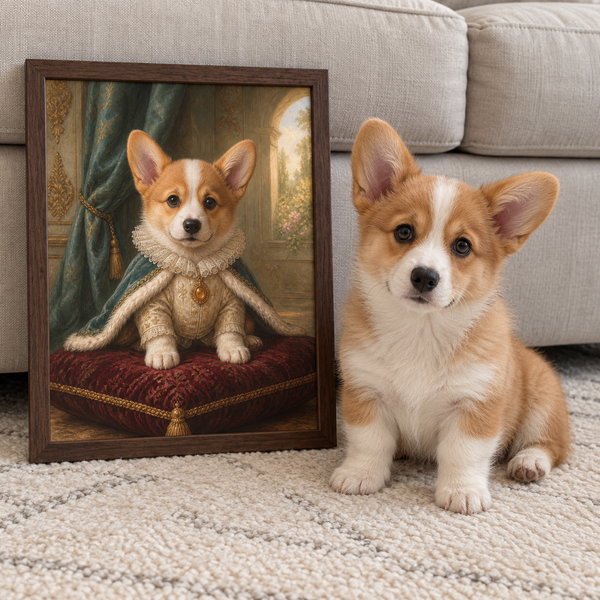
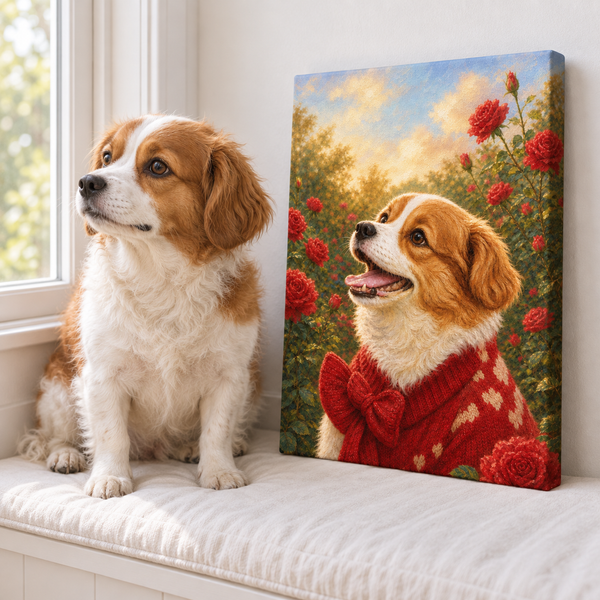
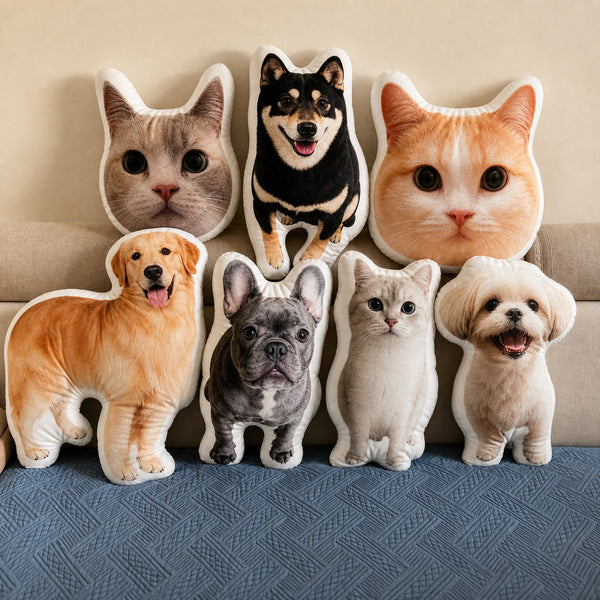

A life-size dog pillow sounds simple until you try to choose a size. Is a 24-inch pillow the size of a 24-inch-tall dog? Will a long dachshund look as substantial as a compact French bulldog? Does “full body” mean the same thing as a standard square pillow printed with a pet photo?
The useful answer begins with shape. A custom cutout pillow follows the visible outline of the dog, and the selected measurement usually describes its longest side. That can create a wonderfully recognizable, almost in-the-room impression, but it is not a promise of exact one-to-one body scale.
This guide explains how to choose a photo, style, and size with realistic expectations.
First, decide what “life-size” means to you
People often use the phrase in three different ways:
- Exact scale: the finished object matches the dog's real measurements.
- Visual presence: the pillow feels substantial beside a couch, chair, or bed.
- Recognizable silhouette: the cutout shape immediately reads as that particular dog.
A personalized pillow is best judged by the second and third meanings. Fabric, seams, stuffing, cropping, and the dog's pose all affect the finished outline. Even when one dimension is close to a real measurement, the pillow is still a soft representation rather than a dimensional replica.
If exact scale matters, measure your dog and compare those measurements with the current product options before ordering. If the goal is emotional presence or a playful gift, focus on a strong silhouette and the room where the pillow will live.
Understand longest-side sizing
Pawfolio's Custom Shaped Pillow currently offers 16-inch, 20-inch, and 24-inch choices measured on the longest side. The longest side may be height or width depending on the photo and pose.
Imagine two dogs placed into the same 24-inch boundary. A sitting dog may use most of that measurement vertically. A stretched-out dog may use it horizontally and end up relatively shallow from back to paws. Both can correctly use the same longest-side measurement while having different overall visual mass.
This is why the largest option is not automatically the most accurate choice. Think about three things together:
- the dog's pose and proportions;
- the available couch, chair, shelf, or bed space;
- whether the pillow should feel like an accent or a noticeable statement piece.
Use painter's tape, a ruler, or a piece of paper to mark 16, 20, and 24 inches in the intended location. That quick test is more informative than imagining the number in isolation.
Choose between a full-body and big-head cutout
The right style depends on what you recognize most about your dog.
Full-body cutout
Choose a full-body shape when posture is part of the personality: a corgi's low stance, a greyhound's elegant outline, a cat's curled sitting pose, or a dog with distinctive patches across the body.
The photo needs to show the complete outline. Ears, paws, chest, and tail should not disappear outside the frame or behind furniture. Sitting and compact lying poses often create a fuller, more stable silhouette than a standing pose with wide gaps between the legs.
Big-head cutout
Choose a big-head style when expression is the main attraction or the available photo is a strong close-up. It can also make better use of a smaller finished size because the eyes, ears, muzzle, and markings occupy more of the surface.
Make sure the entire head and both ears are visible. Leave space around the fur so the cut line does not have to guess where an ear or fluffy edge ends.
Browse the broader custom pillow collection if you are deciding between a silhouette-shaped keepsake and a more conventional decorative pillow.
Use a photo that gives the outline room to work
A beautiful portrait is not always a useful cutout photo. For a shaped pillow, the outer edge matters almost as much as the face.
Look for an image with:
- the dog in focus, especially around the eyes and coat edge;
- even, natural-looking light;
- the full head or body inside the frame;
- minimal overlap from hands, furniture, blankets, or another pet;
- a clear difference between the dog's coat and the background;
- no heavy filter that changes coat or eye color.
The background does not need to be plain, but separation helps. A black dog against a dark couch gives the designer less reliable edge information than the same dog beside a bright wall. Soft daylight from a window or open shade often preserves texture without harsh highlights.
The American Kennel Club's dog photography tips recommend focusing on the eye and photographing near the dog's level. Pawfolio's own Photo Tips emphasize a clear, sharp image with visible ears and markings. Those principles are especially important when the photograph must become a physical outline.
Match the pose to the finished shape
Before uploading, trace the dog mentally with one continuous line. Every protruding element affects the cutout.
A tail held far from the body may make the whole design wider while leaving the central body smaller. A paw extended toward the camera can look oversized because of perspective. A standing pose may create narrow spaces between legs that are difficult to interpret in a soft, stuffed object.
For the most substantial result, consider:
- a front-facing sit with paws close to the body;
- a three-quarter sit that shows expression and chest markings;
- a compact side pose for a dog with a distinctive profile;
- a relaxed curl for a cat or small dog;
- a clean close-up for a big-head design.
Do not force a new pose if your dog is uncomfortable. A familiar seated position in good light will usually provide more useful detail than a strained attempt at symmetry.
Compare the pillow with the room, not only the dog
Scale is partly contextual. A 20-inch shaped pillow may feel large on an accent chair and modest on a king bed. Before choosing, decide where it will spend most of its time.
For a reading chair or child's bed, make sure the widest part will fit without constantly sliding off. For a sofa, consider whether the outline should stand alone or sit among other cushions. If it is a gift, a middle size can be easier to place when you do not know the recipient's exact room dimensions.
Also consider how the image reads from a few feet away. A close, expressive face stays clear at smaller sizes. A long full-body pose with tiny facial details benefits from more surface area.
Review the source image at full size
Phone galleries can make a soft or compressed image look better than it is. Open the file, zoom into the eyes and fur, and check for motion blur, screenshot artifacts, and strong digital zoom. If the face becomes blocky immediately, look for the original file or a second photograph.
Adobe's guide to better phone photos recommends using soft natural light, setting focus on the subject, and avoiding quality loss from digital zoom. If you cannot retake the favorite pose, submit a second clear image that shows the dog's true colors and markings.
Set expectations before you order
Review the current product page for the chosen style, available sizes, customization fields, and proof process. Product details can change, so the live listing should be the final reference rather than an old screenshot or social post.
A convincing life-size dog pillow is less about finding a magic number than combining the right ingredients: a recognizable expression, a clean silhouette, a size that suits the room, and an honest understanding of longest-side measurement. Get those decisions right, and the result can feel surprisingly present without pretending to be an exact replica.