
Choosing between an Art Print and Canvas is not really a contest between a “better” and “worse” material. It is a decision about how you want your pet portrait to live in the room.
An Art Print has a flatter profile and can take on different personalities depending on how it is displayed. A frame can make it crisp and architectural, while an unframed presentation can feel lighter and more relaxed. Canvas brings visible depth, wrapped edges, and the presence of a finished object from the moment it reaches the wall.
If you want the concise specifications first, Pawfolio's Art Print vs Canvas guide compares construction, display, edges, sizes, and the situations each format suits. This article takes a different route: it starts with your room, your existing decor, and the feeling you want the portrait to create.
Begin with the role the portrait will play
Before choosing a format, decide what the portrait is doing in the space.
Some pet portraits are the first thing you want to notice when you enter a room. Others are personal accents placed on a shelf, in an office, or beside family photographs. A large visual anchor benefits from dimension and a clear silhouette. A smaller accent often benefits from the structure a frame can provide.
Ask three simple questions:
- Will the portrait be the room's focal point or part of a group?
- Do you already have frames, wood tones, or metals you want it to match?
- Will people usually see it from across the room or from nearby?
These answers do more than a generic list of pros and cons. They connect the format to the way the artwork will actually be seen.
For a living-room focal point, consider visible depth
A living room often contains several competing shapes: a television, windows, shelving, lighting, and large furniture. A portrait needs enough presence to hold its place among them.
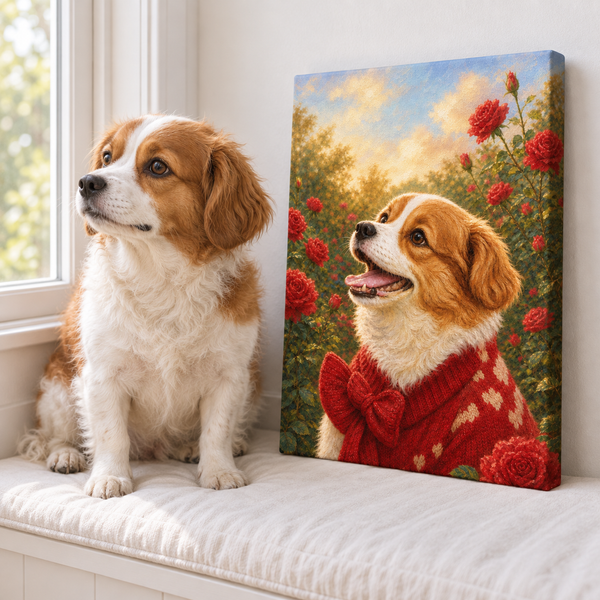
A custom pet Canvas can work especially well above a console, sofa, or fireplace because its gallery-wrapped profile remains visible from an angle. The artwork continues around the wrapped edges, and the solid-wood inner frame gives the piece a dimensional form without requiring an external frame.
Canvas also suits portraits with strong color blocking, dark backgrounds, or a centered pet silhouette. From several feet away, the viewer reads the overall shape first and the smaller details second.
This does not mean every living room needs Canvas. If the room already contains framed photography, line drawings, or a gallery wall, a framed Art Print may integrate more naturally. The key is whether you want the pet portrait to stand slightly apart or join an existing visual system.
For gallery walls, use the flexibility of an Art Print
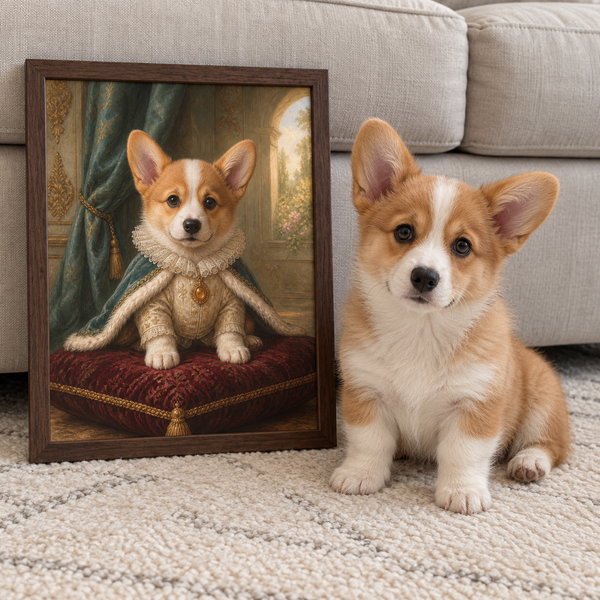
Gallery walls are built on relationships: repeated frame finishes, aligned edges, consistent spacing, or a deliberately varied collection. A flat custom pet Art Print gives you the most control over those relationships.
You can select a frame that echoes the others in the group, add a mat to create breathing room, or use a different frame color to make the portrait the focal point. The premium textured fabric and water-resistant finish give the print a tactile surface while keeping the profile flat.
When framing any displayed print, placement matters. The Library of Congress recommends keeping framed works away from direct or intense light, radiators, vents, and damp exterior walls. Its preservation framing guidance is written for collection care, but the practical placement principles are useful for personal artwork too.
Build the gallery wall on the floor before making holes. Start with the pet portrait, add the largest neighboring piece, and then fill the remaining gaps with smaller photographs or objects. This lets you adjust visual balance without committing too early.
For an office or reading corner, think about viewing distance
In an office, bedroom, or reading corner, you are usually closer to the artwork. Small expressions and quiet background details become more important than overall scale.
An Art Print in a simple frame can make a close-up portrait feel intentional without overwhelming a desk or bookshelf. It also lets you coordinate the portrait with nearby objects: a black frame beside dark hardware, a light-oak frame near natural wood, or a soft mat in a calm neutral room.
Canvas can still work in a small area when you want one self-contained piece rather than several accessories. Choose a size that leaves visible wall space around it. The depth should feel deliberate, not crowded between a shelf and a doorway.
Match the format to the photograph
The source photo affects the result just as much as the material. A sharp face, clear eyes, and visible markings give the artwork more useful information. Pawfolio's Pet Portrait Photo Tips explains how to check focus, light, ear position, and cropping before submitting an image.
For Canvas, pay particular attention to the space around the pet. Because the artwork wraps around the edges, a very tight crop can feel more compressed than expected. A little breathing room around the head, ears, and shoulders helps the composition remain balanced.
For an Art Print, consider how a future mat or frame might change the visible area. Keep essential features away from the extreme edges, especially if you plan to frame the piece independently.
The strongest photo is not always the most formal one. A familiar head tilt, bright-eyed expression, or relaxed pose may tell the story more clearly than a perfectly centered photograph.
Let your existing decor break the tie
If both formats appeal to you, look around the room rather than continuing to compare materials in isolation.
Choose an Art Print when the room already relies on frames, fine lines, layered photographs, or a classic flat-art look. Choose Canvas when the room needs one finished statement piece with depth and a strong edge profile.
Color can break the tie as well. A framed print can borrow a finish from the furniture. Canvas can let a warm background or dark portrait field continue across the edges without introducing another material.
There is no need to make the decision based on trends. The portrait should feel at home with the objects you already intend to keep.
Make the final choice with the display in mind
The most useful summary is straightforward:
- Choose an Art Print for framing flexibility, gallery walls, close viewing, and a classic flat presentation.
- Choose Canvas for wrapped edges, visible depth, and a ready-to-display focal point.
Once the format is clear, confirm the available sizes and display options on the relevant collection page. Then review How It Works so you know what happens after you choose your portrait and submit your photo.
Your pet supplies the personality. The format simply decides how that personality enters the room.